Recommendations for Branding Online Lectures in Indonesia Through Web Scraping with the Implementation of TF-IDF Vectorizer Techniques and K-Means Clustering Algorithm
Article Sidebar
Main Article Content
Abstract
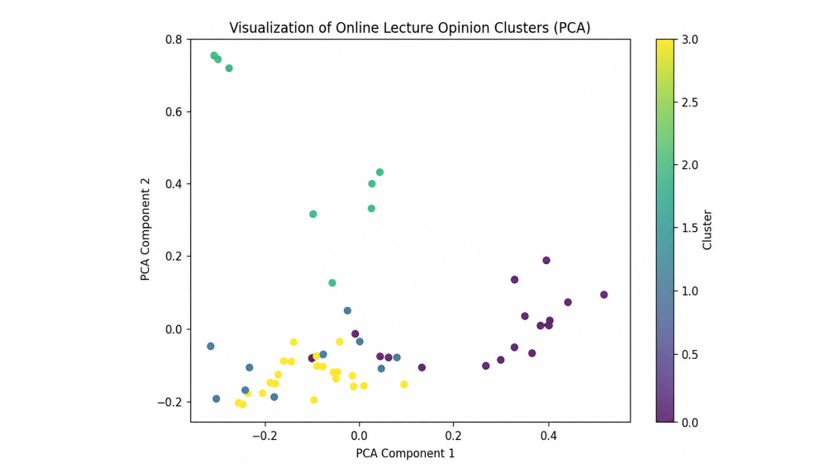
The development of online lectures in Indonesia has encouraged universities to develop more targeted branding strategies, particularly in increasing brand awareness and digital engagement. Public perceptions reflected in open digital sources, particularly online news portals, are important data sources for understanding how online lectures are perceived by the public. This study aims to analyze public opinion on online lectures in Indonesia using web scraping, text mining, TF-IDF Vectorizer, and the K-Means Clustering algorithm. Initial data was obtained through web scraping using several Indonesian keywords related to online lectures and resulted in 108 text documents. After duplicate removal, noise filtering, and text preprocessing, the number of documents used in the analysis was reduced to 60 documents. The analysis stages included text cleaning, normalization, feature extraction using TF-IDF, determining the optimal number of clusters using the Elbow Method and Silhouette Score, and clustering using K-Means. The results showed that the optimal number of clusters was 4 clusters. The formed clusters represent the themes of online lecture academic activities, social and cultural dimensions, distance education and policy, as well as economic, regulatory, and technological aspects. The TF-IDF matrix yielded 1669 features, while the final evaluation yielded a Silhouette Score of 0.0345. PCA visualization showed overlap between clusters, indicating that public perception of online lectures is multidimensional. The conclusion of this study shows that the TF-IDF and K-Means approaches can be used to map public opinion and develop more contextual, data-driven, and relevant online lecture branding recommendations for universities.
Article Details
Section

This work is licensed under a Creative Commons Attribution-NonCommercial-ShareAlike 4.0 International License.
How to Cite
References
E. Wahyudinarti, P. Andini Rachmatika, dan R. Nurul Ain, “Meningkatkan Efektivitas Pembelajaran Mahasiswa dengan AI,” JATI (Jurnal Mahasiswa Teknik Informatika), vol. 9, no. 1, hlm. 488–491, Des 2024, doi: 10.36040/jati.v9i1.12279.
R. Sahara, S. Abdullah, dan M. I. Saputra, “Integration Model of Academic Information Systems and Learning Management Systems with REST Web Services Using External Databases,” Journal of Information and Organizational Sciences, vol. 47, no. 2, hlm. 373–384, Des 2023, doi: 10.31341/jios.47.2.7.
F. A. A. Ompo dan M. A. I. Pakereng, “Penerapan Text Mining Untuk Advertising Pada Data Tweets Zalora Indonesia Dengan Menggunakan Metode K-Means Clustering,” Progresif: Jurnal Ilmiah Komputer, vol. 20, no. 1, hlm. 314, Feb 2024, doi: 10.35889/progresif.v20i1.1576.
H. T. A. Simanjuntak, P. E. P. Silaban, J. K. S. Manurung, dan V. H. Sormin, “Klasterisasi Berita Bahasa Indonesia Dengan Menggunakan K-Means Dan Word Embedding,” Jurnal Teknologi Informasi dan Ilmu Komputer, vol. 10, no. 3, hlm. 641–652, Jul 2023, doi: 10.25126/jtiik.20231026468.
M. T. Razaq, D. Nurjanah, dan H. Nurrahmi, “Analisis Sentimen Review Film Menggunakan Naive Bayes Classifier dengan Fitur TF-IDF,” eProceedings of Engineering, vol. 10, no. 2, hlm. 1698–1712, Apr 2023, Diakses: 15 April 2025. [Daring]. Tersedia pada: https://openlibrarypublications.telkomuniversity.ac.id/index.php/engineering/article/view/19997
A. Aziz dan Fauziah, “Analisis Sentimen Identifikasi Opini Terhadap Produk, Layanan dan Kebijakan Perusahaan Menggunakan Algoritma TF-IDF dan SentiStrength,” Jurnal Sains Komputer & Informatika (J-SAKTI, vol. 6, no. 1, hlm. 115–125, Mar 2022, Diakses: 15 April 2025. [Daring]. Tersedia pada: https://tunasbangsa.ac.id/ejurnal/index.php/jsakti/article/view/430
A. Gondowastradmojo dan R. Kusumastuti, “Analisis Sentimen Ulasan di Tokopedia Dengan Metode Naive Bayes,” dalam Seminar Nasional AMIKOM Surakarta (SEMNASA) 2024, Sukoharjo: STMIK Amikom Surakarta, Nov 2024, hlm. 369–382.
H. Hassani, C. Beneki, S. Unger, M. T. Mazinani, dan M. R. Yeganegi, “Text Mining in Big Data Analytics,” Big Data and Cognitive Computing, vol. 4, no. 1, hlm. 1, Jan 2020, doi: 10.3390/bdcc4010001.
F. D. Adhiatma dan A. Qoiriah, “Penerapan Metode TF-IDF dan Deep Neural Network untuk Analisa Sentimen pada Data Ulasan Hotel,” Journal of Informatics and Computer Science (JINACS), hlm. 183–193, Nov 2022, doi: 10.26740/jinacs.v4n02.p183-193.
I. M. A. Purniawan, G. M. A. Sasmita, dan I. P. A. E. Pratama, “Clustering Berita menggunakan Algoritma TF-IDF dan K-Means dengan Memanfaatkan Sumber Data Crawling pada Situs Detik.com,” JITTER : Jurnal Ilmiah Teknologi dan Komputer, vol. 3, no. 1, hlm. 821–830, Jan 2022, doi: 10.24843/JTRTI.2022.v03.i01.p18.
H. fonda Fonda, B. Mustika, E. Sabna, dan Y. Irawan, “Implementasi Text Mining pada Twitter dengan Algoritma K-Means Clustering sebagai Dasar Kebijakan Marketing Biro Perjalanan Wisata,” Jurnal Ilmu Komputer, vol. 9, no. 2, hlm. 134–147, Okt 2020, doi: 10.33060/jik/2020/vol9.iss2.180.
I. K. Saputri, T. Setiadi, dan L. Zahrotun, “Penerapan Text Mining Pengelompokkan Judul Kerja Praktek Menggunakan Metode K-Means Clustering dengan Cosine Similarity,” Jurnal Sarjana Teknik Informatika, vol. 6, no. 3, hlm. 87–95, Nov 2018, [Daring]. Tersedia pada: http://journal.uad.ac.id/index.php/JSTIF
I. Alfian, “Penerapan Metode K-Means Dalam Melakukan Pengelompokan Bencana Alam di Indonesia Dilakukan dengan Memanfaatkan Teknik Text Mining,” Jurnal Algoritma, vol. 20, no. 1, hlm. 139–147, Mei 2023, doi: 10.33364/algoritma/v.20-1.1275.
P. A. N. Aryanti dan I. B. M. Mahendra, “Analisis Sentimen Opini Berbahasa Indonesia Pada Sosial Media Menggunakan TF-IDF dan Support Vector Machine,” Jurnal Elektronik Ilmu Komputer Udayana, vol. 12, no. 1, hlm. 45–52, Jul 2023, Diakses: 15 April 2025. [Daring]. Tersedia pada: https://ojs.unud.ac.id/index.php/jlk/article/view/JLK.2023.v12.i01.p06/48126
S. A. Curiskis, B. Drake, T. R. Osborn, dan P. J. Kennedy, “An evaluation of document clustering and topic modelling in two online social networks: Twitter and Reddit,” Inf. Process. Manag., vol. 57, no. 2, hlm. 102034, Mar 2020, doi: 10.1016/j.ipm.2019.04.002.
Y. Poulakis, C. Doulkeridis, dan D. Kyriazis, “A Survey on AutoML Methods and Systems for Clustering,” ACM Trans. Knowl. Discov. Data, vol. 18, no. 5, hlm. 1–30, Jun 2024, doi: 10.1145/3643564.
V. Mehta, M. Agarwal, dan R. K. Kaliyar, “A comprehensive and analytical review of text clustering techniques,” Int. J. Data Sci. Anal., vol. 18, no. 3, hlm. 239–258, Sep 2024, doi: 10.1007/s41060-024-00540-x.
M. Alzate, M. Arce-Urriza, dan J. Cebollada, “Mining the text of online consumer reviews to analyze brand image and brand positioning,” Journal of Retailing and Consumer Services, vol. 67, hlm. 102989, Jul 2022, doi: 10.1016/j.jretconser.2022.102989.
M. R. Borbon dan R. A. Ebardo, “Social media discussions on educators: Selecting and appraisal of recent research using TF-IDF,” Computers and Education Open, vol. 9, hlm. 100293, Des 2025, doi: 10.1016/j.caeo.2025.100293.
Q. Wan, X. Xu, dan J. Han, “A dimensionality reduction method for large-scale group decision-making using TF-IDF feature similarity and information loss entropy,” Appl. Soft Comput., vol. 150, hlm. 111039, Jan 2024, doi: 10.1016/j.asoc.2023.111039.
J. Zhou, Z. Ye, S. Zhang, Z. Geng, N. Han, dan T. Yang, “Investigating response behavior through TF-IDF and Word2vec text analysis: A case study of PISA 2012 problem-solving process data,” Heliyon, vol. 10, no. 16, hlm. e35945, Agu 2024, doi: 10.1016/j.heliyon.2024.e35945.
M. A. Mahdi, K. M. Hosny, dan I. Elhenawy, “Scalable Clustering Algorithms for Big Data: A Review,” IEEE Access, vol. 9, hlm. 80015–80027, 2021, doi: 10.1109/ACCESS.2021.3084057.
V. Mehta, S. Bawa, dan J. Singh, “WEClustering: word embeddings based text clustering technique for large datasets,” Complex & Intelligent Systems, vol. 7, no. 6, hlm. 3211–3224, Des 2021, doi: 10.1007/s40747-021-00512-9.
J. Ravi dan S. Kulkarni, “Text embedding techniques for efficient clustering of twitter data,” Evol. Intell., vol. 16, no. 5, hlm. 1667–1677, Okt 2023, doi: 10.1007/s12065-023-00825-3.
B. Amiri dan R. Karimianghadim, “A novel text clustering model based on topic modelling and social network analysis,” Chaos Solitons Fractals, vol. 181, hlm. 114633, Apr 2024, doi: 10.1016/j.chaos.2024.114633.
M. Yuan, P. Lin, dan J. Zobel, “Document Clustering vs Topic Models: A Case Study,” dalam Australasian Document Computing Symposium, New York, NY, USA: ACM, Des 2021, hlm. 1–8. doi: 10.1145/3503516.3503527.
G. Costa dan R. Ortale, “Document Clustering Meets Topic Modeling with Word Embeddings,” dalam Proceedings of the 2020 SIAM International Conference on Data Mining, Philadelphia, PA: Society for Industrial and Applied Mathematics, 2020, hlm. 244–252. doi: 10.1137/1.9781611976236.28.
H. Ito dan B. Chakraborty, “Social Media Mining with Dynamic Clustering: A Case Study by COVID-19 Tweets,” dalam 2020 11th International Conference on Awareness Science and Technology (iCAST), IEEE, Des 2020, hlm. 1–6. doi: 10.1109/iCAST51195.2020.9319496.
D. F. Surianto dan D. F. Surianto, “Enhancing K-Means Clustering for Journal Articles using TF-IDF and LDA Feature Extraction,” Brilliance: Research of Artificial Intelligence, vol. 4, no. 2, hlm. 964–972, Mar 2025, doi: 10.47709/brilliance.v4i2.5547.
J. R. Trillo, E. Herrera-Viedma, J. A. Morente-Molinera, dan F. J. Cabrerizo, “A large scale group decision making system based on sentiment analysis cluster,” Information Fusion, vol. 91, hlm. 633–643, Mar 2023, doi: 10.1016/j.inffus.2022.11.009.